

This opinion piece by Sarika Panda Bhatt for The Stasteman on October 1, 2026. You can read the original article: Click here…
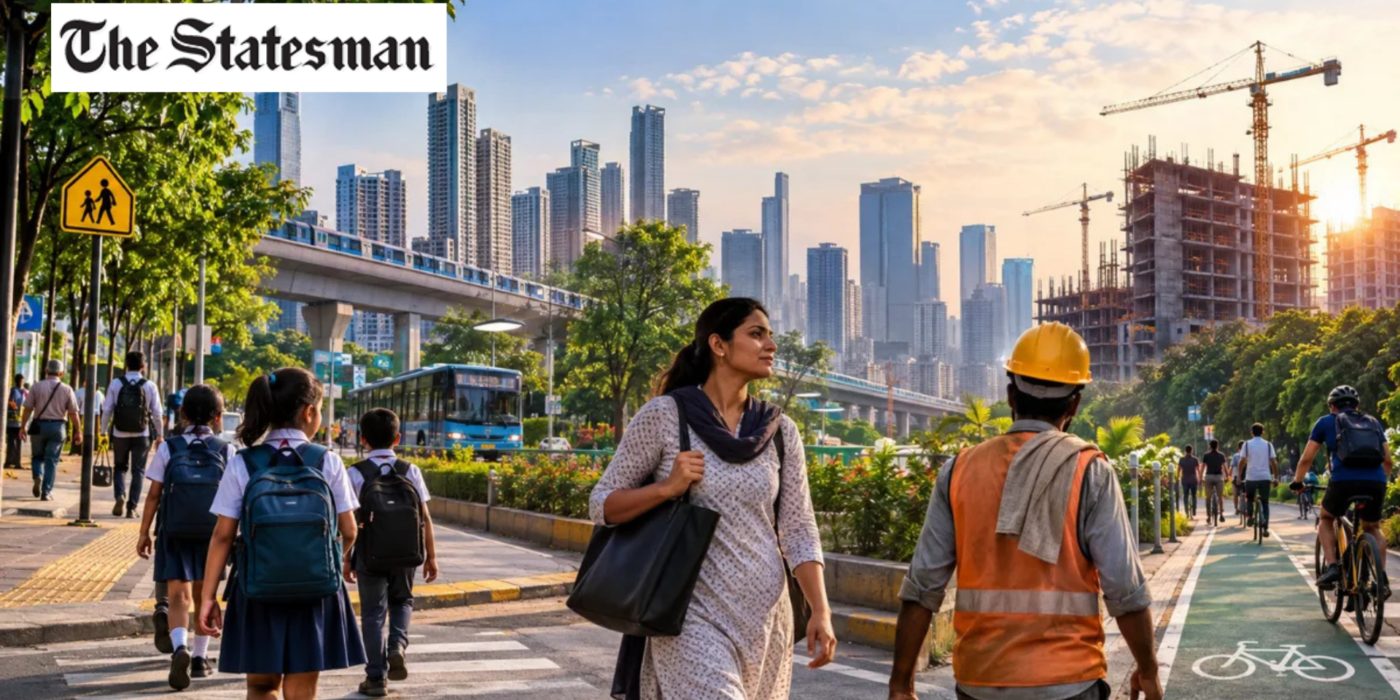
Let me ask you a question. Really think about it. Can a child walk safely to school in your city? Can a woman travel to work without fear? Can a construction worker afford to live near the site she helps build?
On World Cities Day, with the theme ‘Regenerating the City: Adequate Housing for All’, these are the questions India’s urban debate must address. Housing lays the foundation of an inclusive city, but a house by itself isn’t adequate. Without all the other things that make a city convenient — transport, jobs, access to healthcare, good schools, clean water and parks — a house is just four walls.
What India shows us
UN-Habitat estimates that up to 3.4 billion people worldwide lack adequate housing, and over 1.1 billion live in informal settlements. In India, a 2025 committee of NITI Aayog and the Housing Ministry estimated a shortage of five to seven crore homes.
India’s urban population is projected to reach 600 million by 2036, with cities expected to account for 70 per cent of the country’s GDP.
But in cities such as Gurugram, Noida, Pune and Hyderabad, expansion has outstripped liveability. Our investments in infrastructure are nowhere near the levels required to keep pace with growth. Congestion, inadequate footpaths, unsafe crossings, poor public transport, flooding, pollution and rising temperatures are daily challenges. Are we building cities to live in, or are we just building?
What the world shows us
Singapore houses about 80 per cent of resident households in public housing, with over 90 per cent of them owning their homes. What matters is that housing is planned alongside transport, schools, clinics and parks as part of one ecosystem. Similarly, in the Netherlands, 27 per cent of all journeys are made by bicycle because the country treats walking and cycling as genuine modes of transport and invests accordingly.
What we must learn is that a city cannot call itself modern if a child cannot walk to school, a person with a disability cannot use the footpath, or a worker loses hours commuting.
Furthermore, climate risk makes this issue all the more urgent. A 2025 World Bank assessment of 24 Indian cities found that urban heat island effects can raise city-centre temperatures by 3–4°C and that timely adaptation could save over 130,000 lives from extreme heat by 2050. These are decisions about housing, drainage, roads and land use that we are making now. The neighbourhoods with the least shade, drainage and tree cover are usually those where the poorest families live. Heat, therefore, is also a question of equity.
Streets are where all of this becomes visible. Through Raahgiri Day, which opens roads to people on Sunday mornings in Haryana and other Indian cities, we have watched children cycle, women walk without hurry, and families reclaim space that is otherwise surrendered to traffic.
The appetite for safe public spaces is already there. What is missing is the habit of designing for them every day of the week. A street that works for an eight-year-old and an eighty-year-old works for everyone, and cities that learn this early spend far less repairing the damage later.
The missing piece: The care economy
We build our cities around homes, offices and factories while treating daycare centres, eldercare facilities, clinics and community spaces as additional components.
This is reflected in India’s Time Use Survey 2024: 41 per cent of women aged 15–59 perform unpaid caregiving, compared with 21.4 per cent of men. Women spend 140 minutes per day on such activities, compared with 74 minutes for men.
Women’s participation in work and public life is constrained where care infrastructure is absent.
So, here are the shifts we, as a country, should strive to make.
Five shifts India needs
- Plan housing and mobility together. Affordable homes far from jobs create a new form of exclusion through long, costly commutes.
- Treat social infrastructure as core infrastructure. Schools, childcare, healthcare and parks belong in the plan, not as an afterthought.
- Build climate resilience into planning. Water bodies, urban forests, shaded streets and water-sensitive design are public health investments, not beautification.
- Make safety and accessibility non-negotiable. Road safety should be measured by whether people can walk, cycle and use public transport safely, not by vehicle speed. Gender-responsive design and safe school zones must become standard.
- Strengthen urban governance. Housing, transport, water and health cannot continue to operate in silos. Urban local bodies need capacity, finances and authority, while communities need a meaningful voice.
- What’s important is that regeneration must not displace the people who made these neighbourhoods. Rising property values mean little if the original residents can no longer afford to stay.
Anti-displacement safeguards, such as security of tenure and affordable rental housing, should be built into every regeneration plan from the start. Without them, regeneration simply moves the problem somewhere less visible.
The actual measure
Looking at the bigger picture, much of the urban infrastructure India will have in 2046 is yet to be built. We can repeat old mistakes or choose a different model.
What we must do is stop counting houses, kilometres and inaugurations, and start counting lives improved, opportunities created and inequalities reduced.
A successful city is one where every person, regardless of income, gender, age or ability, can live with dignity, move safely and feel that the city belongs to them.
That is the city India must aspire to build.